Cats and Dogs
abolish ICE

During the 2024 presidential election, Donald Trump responded to a question about a bipartisan border security bill by insisting that, “In Springfield, they are eating the dogs. The people that came in, they are eating the cats. They’re eating – they are eating the pets of the people that live there.”
He was referring to a debunked hoax popularized by conservative media which claimed Haitian immigrants were eatings the pets of local residents. During the debate, the commentator addressed the fact that this story was simply not true. It didn’t matter. That was the soundbite of the night.
Why this lie? What is the salience of this story, so easy to disprove, so seemingly random? Trump and his ilk profit off the absurd, the quotable, the remixable. But this specific accusation highlights a bordering logic with deeper roots.
To understand its significace, we might turn to the work of anthropologist Edmund Leach, who writes about human/animal relations as marked by “social distance” mirroring incest taboos. Leach theorizes that animal “eatability” is determined by physical and emotional closeness. Cats and dogs live within our homes and are considered parts of our families. They are too close to be eaten. Animals like lions and zebras are far away: in zoos, or foreign countries. It would be too strange to eat these animals because they are too distant. Alternatively, cows, pigs, and chickens live on the land surrounding our homes (at least traditionally). They are not relatives like cats and dogs. They are both of us and not us, and therefore able to be safely consumed.
This proximity framework is imagined as a projection of an incest taboo upon human/animal relations. While different cultures have different incest taboos–for example, marriage between cousins is considered preferential in many places, but generally not in the United States–the notion of an incest taboo itself is universal. That is, there is no known culture without some restrictions on marital relations.
A similar distance-based logic underlies these taboos. In the US context, marriage to someone in one’s immediate family is unthinkable, as these relatives are “too close.” Marrying someone entirely outside one’s community and culture is still a taboo, if not as pervasively as years ago. Still, consider the spectacle of television shows like 90-Day Fiancee, or the sort of collective disgust directed at men who seek partnerships arranged by international marriage agencies. Suitable partners fall in the “cows and pigs” territory: neighbors, community members, people with similar circumstances.
When immigrants are accused of eating cats and dogs, it evokes both disgust and a shadow of the incest taboo, a kind of perversion. These people who will eat anything could do anything to us, too. Of course, this thinking throws cultural relativism out the window and fails to truly consider the moral equivalence of eating dogs and cows, pigs or cats, etc. Rumors about immigrant groups eating pets have long been a racist scare tactic. In the 1880s, Chinese immigrants were ridiculed for eatings “dogs, cats, and rats” and these stereotypes resurfaced when Cambodian refugees fleeing Khmer Rouge arrived in the United States. Then and now, claiming that immigrants steal and eat the pets of others is a way to invoke a fear of invasion, a question about the security of the private home. It’s akin to accusing immigrants of stealing away the children of white families, but stranger and therefor stickier in the collective consciousness.
Cut to 2026. The Trump administration has enacted most of what he said he would do during that 2024 debate: sending ICE en masse to terrorize migrants and citizens, occupying cities, and deporting people without due process. This month, DHS Secretary Kristi Noem attempted to end Temporary Protected Status for Haitian immigrants, which would leave 350,000 people vulnerable to deportation to a country facing one of the worst documented humanitarian crises in the world. Judge Ana C. Reyes temporarily blocked the motion. In her 83-page opinion, she opens with Noem’s own tweet:
“I am recommending a full travel ban on every damn country that’s been flooding our nation with killers, leeches, and entitlement junkies.
Our forefathers built this nation on blood, sweat, and the unyielding love of freedom — not for foreign invaders to slaughter our heroes, suck dry our hard-earned tax dollars, or snatch the benefits owed to AMERICANS.
WE DON’T WANT THEM. NOT ONE.”
Judge Reyes states that not only were Noem’s actions illegal and unconstitutional, but per her own words, they are clearly based in profound xenophobic racism.
This is not the first time that Noem’s own words have been used against her. When returning to those cats and dogs in Springfield, one might remember Noem’s treatment of animals. In her memoir No Going Back, Noem describes taking her puppy, Cricket, to a gravel pit to put a bullet in its head. “I hated that dog,” Noem writes, calling the 14 month old Whippet “untrainable”, “dangerous to anyone she came in contact with” and “less than worthless…as a hunting dog.”
This was how many people were introduced to Noem as a public figure, and she was both condemned and ridiculed for an act many saw as somewhat sociopathic. It’s sort of a perfect punchline, until you consider that shooting a puppy is more provocative in American politics than Noem’s early offer to “drive more razor wire” to the Rio Grande to prevent migrants from crossing the river–or really, to increase the number of deaths of men, women, and children seeking safety in the United States.
In Noem’s estimation, this story served to show how she could roll up her sleeves and get ugly work done. That she could be cruel to protect her children from threat, however ambiguous, and the community at large. In her story, the puppy is unredeemable, criminal, deviant. A killer. A leech.
The violence of border maintenance always requires these kinds of moral inversions. To find ugliness in the vulnerable, infamy in the innocent. Fundamentally, bordering is a practice in cutting off the interconnectedness of the human family. This family already includes these animal others–the creatures we kill and eat, the creatures we love and fear. And so these animal others are easy actors to project discomfort and cruelty to the human stranger, though of course migrants are not strange, but systematically estranged.
Consider Alligator Alcatraz, the operationalization of locally exotic creatures to act as guards against the people the government has deigned disposable. Not for the first time, as many have pointed out, given the stomach-turning history of the term “alligator bait” being weaponized against Black children. If we apply Leach’s theory here, we can see how “strange” people are placed in “strange” quarters, tossed off to be handled by our most un-familiar animals.
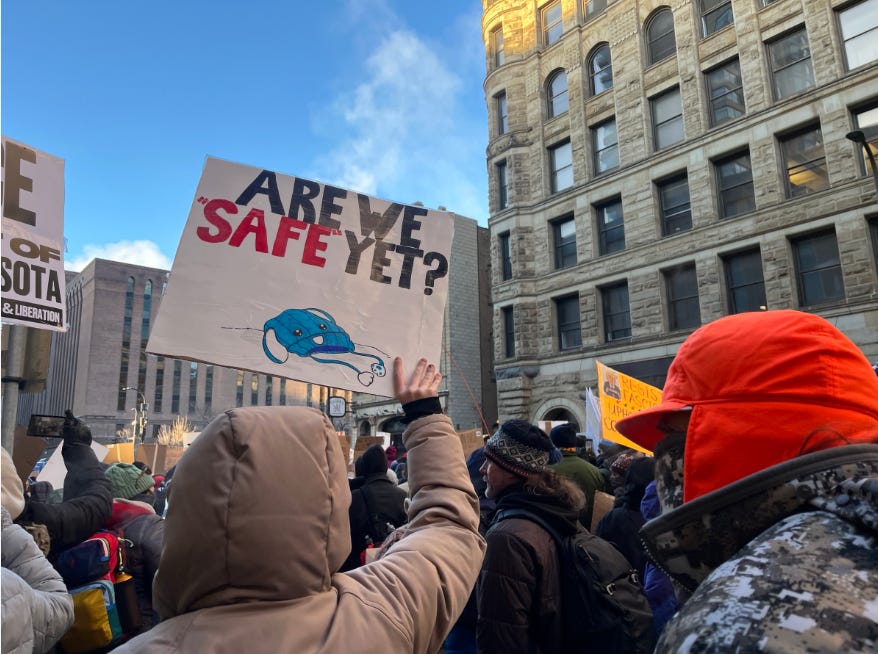
I couldn’t help but think about this animal mirror-world when I saw the picture of Liam Conejo Ramos, standing in the snow in his blue bunny hat, towered over by ICE agents. A little boy who found joy in the animal-ness of his name. A little boy whose vulnerability was exploited, used as bait like a rabbit. A little boy who is now afraid of strangers and cries out for his father at night. A little boy whose family followed all the protocols necessary to seek asylum in the United States, for whatever that is worth.
This image moved the country because it called upon a duty of care. People should not have to be turned into prey to be valued, shown at their most vulnerable, nor do they need to be innocent or good to be afforded their place in the human family. But in part I do think it was this sign from the animal world that reoriented the public to find shared humanity, that the symbol of the little rabbit reflected the vulnerability and preciousness of this sweet boy back onto him at a time when even children are conceptualized as threats to the nation.
A theoretical text about linguistic anthropology is admittedly strange source material for dealing with the pressing present moment, but I find Leach’s work helpful for uncovering how we are taught to accept certain logical systems of relating to each other. Considering the use of these animal taxonomies by Trump and other hatemongers reveals how deeply entrenched division and hierarchy are in human relations. The white supremacist engineers of this bordering regime desperately want us to believe that violent, systemic xenophobia is somehow natural. But of course that is not the case. Whether it’s the Springfield lie, Alligator Alcatraz, or the weaponization of the sea and the desert against people seeking safety, these men have jammed their hands into natural symbols like puppets and forced them to pantomime their bordering logic. Left to speak freely, the natural world tells us that migration is ancient, essential, sacred–if only we listen.
incredible
Wow